

If you manage diabetes on Medicare, you’ve probably run into this puzzle: your test strips come from one part of Medicare, your insulin from another, and the same insulin can be covered two completely different ways depending on how you take it. It’s one of the most confusing splits in all of Medicare, and misunderstanding it is how people end up paying full price for supplies that should have been mostly covered.
The short version: Medicare Part B treats testing equipment and durable insulin pumps as medical equipment, while Medicare Part D treats insulin, oral medications, and injection supplies as prescriptions. Which side of that line an item falls on determines what you pay, where you can get it, and which rules apply. Roughly one in four people on Medicare lives with diabetes, so getting this right matters for a lot of households.
At The Medicare Family, we explain Medicare in simple English so you can stop guessing and start planning. In this guide, we’ll walk through exactly which supplies fall under Part B versus Part D, what they cost in 2026, the $35 insulin cap, and the supplier rule that catches people off guard. If you’d like help finding a plan that covers your specific supplies and medications, schedule your FREE call with a licensed Medicare expert at no cost or pressure.
The Part B vs. Part D Split at a Glance
Here’s the whole picture in one place. The dividing line is simpler than it looks: equipment and devices generally fall under Part B, while things dispensed at the pharmacy generally fall under Part D.
| Supply or medication | Covered by | What you typically pay in 2026 |
| Blood glucose meters, test strips, lancets | Part B (DME) | 20% after the $283 Part B deductible |
| Continuous glucose monitors (CGMs) | Part B for most people (see note below) | 20% after the Part B deductible |
| Durable insulin pump and the insulin used in it | Part B (DME) | 20% for the pump; pump insulin capped at $35 per month |
| Insulin you inject or inhale | Part D | Capped at $35 per month per covered insulin, no deductible |
| Disposable patch pumps and their insulin | Part D | Varies by plan formulary; the $35 cap may not apply to pods |
| Syringes, needles, pens, alcohol swabs, gauze | Part D | Varies by plan; deductible and copays may apply |
| Oral diabetes medications (metformin, etc.) | Part D | Varies by plan tier |
| Therapeutic shoes or inserts | Part B | 20% after the Part B deductible |
Now let’s walk through what each side actually means for you.
What Part B Covers: Equipment and Testing Supplies
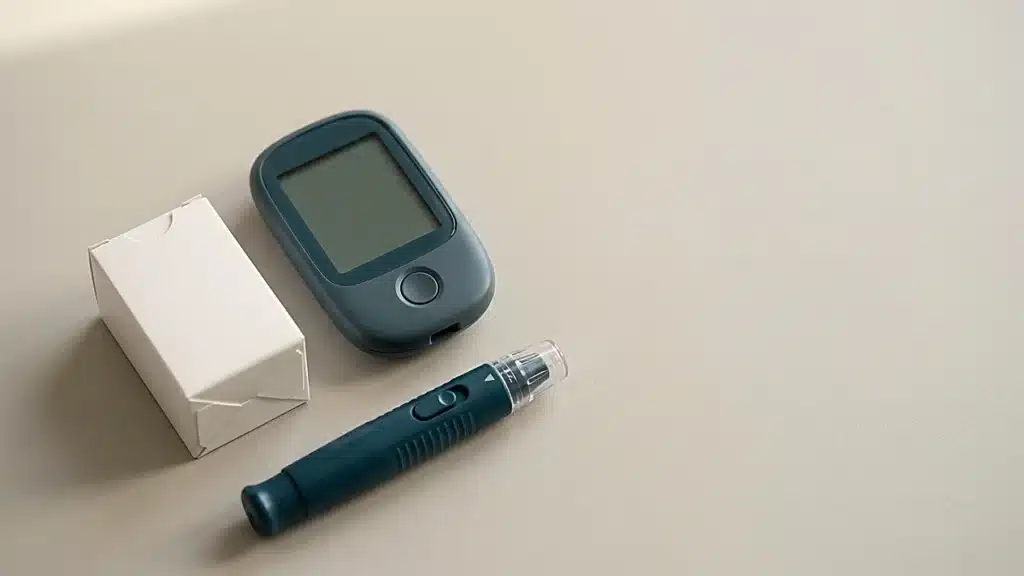
Medicare Part B treats most diabetes testing equipment as durable medical equipment (DME). With a doctor’s prescription confirming your diabetes and medical need, Part B helps pay for blood glucose monitors, test strips, lancets and lancing devices, glucose control solution, durable external insulin pumps, and therapeutic shoes or inserts if you have diabetes related foot problems.
You generally pay 20% of the Medicare approved amount after meeting the Part B deductible ($283 in 2026), and Medicare pays the other 80%. There are also quantity limits worth knowing: Medicare typically covers up to 300 test strips and 300 lancets every three months if you use insulin, or 100 of each if you don’t. Your doctor can document medical necessity for more if you need them.
Part B also fully covers several preventive services with no deductible or coinsurance at all, including diabetes screenings (up to two per year if you’re at risk), diabetes self management training, and medical nutrition therapy when referred by your doctor. These are benefits many people never use simply because they don’t know they exist.
A note on continuous glucose monitors
CGMs like Dexcom and FreeStyle Libre have been covered under Part B as durable medical equipment, with eligibility expanded in recent years so that far more people with diabetes qualify with a doctor’s prescription. Some 2026 policy updates may change how certain CGMs are billed, with some beneficiaries receiving them through their drug plan’s pharmacy benefit instead. Because this affects what you pay and where you pick them up, check with your plan or supplier about how your specific CGM will be billed this year, or ask us and we’ll help you sort it out.
What Part D Covers: Insulin, Medications, and Injection Supplies
Medicare Part D (or a Medicare Advantage plan that includes drug coverage) handles the pharmacy side: insulin you inject or inhale, oral diabetes medications like metformin, non insulin injectables prescribed for diabetes, and the supplies used to administer insulin, including syringes, needles, pens, alcohol swabs, and gauze.
What you pay depends on your plan’s formulary and tiers, and your plan’s deductible may apply to some items. One important exception: covered insulin has special cost protections, which brings us to the rule that helps the most.
The $35 Insulin Cap
Since the Inflation Reduction Act took effect, your out of pocket cost for a one month supply of each covered insulin is capped at $35, and the deductible does not apply to it. If your insulin used to cost you $100 or more a month, that’s a substantial, automatic saving.
The same cost protection applies to insulin used with a durable Part B covered pump. One caveat: the cap applies to insulins your plan covers, and plans can prefer certain brands, so if your specific insulin isn’t on your plan’s list, comparing plans during enrollment season matters. And insulin used in disposable pods may fall outside the cap, which is worth checking before you assume.
The Insulin Rule That Confuses Everyone
Here’s the strangest part of the whole system: the same insulin can be covered by different parts of Medicare depending on how it enters your body.
- Insulin used in a durable external pump is covered under Part B, because Medicare treats it as part of the equipment. It’s subject to Part B rules, with the monthly cost of the insulin itself capped.
- Insulin you inject with a syringe or pen, or inhale, is covered under Part D as a prescription, capped at $35 per covered insulin per month.
- Disposable patch pumps (like pod style devices) generally aren’t Part B equipment. They and their insulin typically run through Part D, where coverage and cost depend on your plan’s formulary.
So two neighbors using the exact same insulin can pay differently and shop differently, purely because one uses a durable pump and one uses pens. If you’re considering changing how you take insulin, it’s worth understanding the coverage side before you do, alongside your doctor’s medical guidance.
The Supplier Rule That Catches People Off Guard
For Part B supplies, Medicare only pays if you buy from a Medicare enrolled supplier. A pharmacy or mail order company that isn’t enrolled can still sell you test strips, but Medicare won’t pay a penny toward them, and you’ll be stuck with the full price.
Before you set up a refill or order supplies, ask one direct question: “Are you enrolled in Medicare, and do you accept assignment?” Accepting assignment means the supplier agrees to Medicare’s approved amount as full payment, which keeps your share at the standard 20% and nothing more. It’s a two minute question that prevents a surprise bill.
How to Lower Your Diabetes Costs Further
- A Medicare Supplement (Medigap) plan can pick up the 20% coinsurance on your Part B supplies. For someone using test strips, a CGM, or a pump year round, that 20% adds up, and most Medigap plans cover it in full.
- Extra Help (the Part D Low Income Subsidy) substantially reduces prescription costs for people with limited income and resources, often bringing copays down to just a few dollars.
- Medicare Advantage plans must cover the same diabetic supplies as Original Medicare, and some add extras like over the counter allowances that can help with testing supplies. Just weigh networks, formularies, and total costs, not the extras alone.
- Compare plans every fall. Formularies, preferred pharmacies, and supply rules change each year. The Annual Enrollment Period (October 15 to December 7) is your window to make sure your plan still fits the supplies and medications you actually use.
Frequently Asked Questions
Are diabetic supplies covered under Medicare Part B or Part D?
Both, depending on the item. Part B covers testing equipment and devices as durable medical equipment, including blood glucose monitors, test strips, lancets, durable insulin pumps, and therapeutic shoes, generally at 20% coinsurance after the deductible. Part D covers insulin you inject or inhale, oral diabetes medications, and injection supplies like syringes, needles, and pens through your drug plan.
How much does insulin cost with Medicare in 2026?
Your out of pocket cost for a one month supply of each insulin covered by your Part D plan is capped at $35, and no deductible applies to it. Insulin used with a durable Part B covered pump has similar cost protection. Insulin used in disposable pods may fall outside the cap, and plans can prefer certain brands, so check that your specific insulin is on your plan’s list.
Why won’t Medicare pay for my test strips?
The most common reason is buying from a supplier that isn’t enrolled in Medicare, because Part B only pays enrolled suppliers. Other common reasons include exceeding the quantity limits (typically 300 strips per three months for insulin users, 100 for non users) without documentation of medical need, or not having a prescription on file. Ask your supplier whether they’re Medicare enrolled and accept assignment before ordering.
Does Medicare cover CGMs like Dexcom or FreeStyle Libre?
Yes. CGMs have been covered under Part B as durable medical equipment for people with diabetes who have a doctor’s prescription, with eligibility expanded significantly in recent years. Some 2026 policy updates may shift how certain CGMs are billed, with some beneficiaries receiving them through their drug plan’s pharmacy benefit instead, so confirm with your plan or supplier how yours will be billed this year.
The Takeaway
Medicare covers diabetes care well, but it splits that coverage down the middle: Part B for equipment and testing supplies, Part D for insulin, medications, and injection supplies, with the pump insulin exception straddling the line. Knowing which side each item falls on tells you what you’ll pay, where to buy it, and which rules apply, and the $35 insulin cap plus the Medicare enrolled supplier rule are the two details that save people the most money and the most grief.
If sorting your supplies across plans, formularies, and suppliers sounds like a headache, that’s what we’re here for. At The Medicare Family, we’ve spent more than 40 years helping people across all 50 states find coverage that fits the care they actually use. We represent 30+ of the nation’s top insurance companies, check that your medications and supplies are covered before you enroll, and support you for life, all at no cost to you. Schedule your FREE call today. You can also review Medicare’s diabetes coverage any time on Medicare.gov.


